


Đề thi Tiếng Anh vào 10 Sở Hà Nội 2026 - Gợi ý đáp án
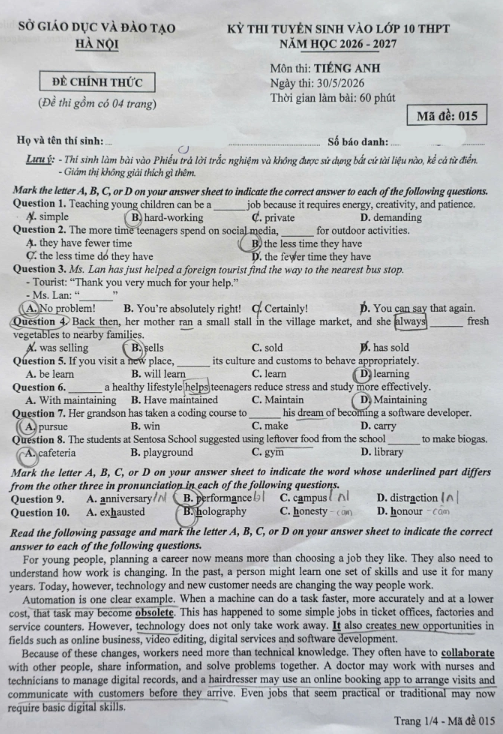
SỞ GIÁO DỤC VÀ ĐÀO TẠO HÀ NỘI
KỲ THI TUYỂN SINH VÀO LỚP 10 THPT NĂM HỌC 2026 - 2027
Môn thi: TIẾNG ANH
Mã đề: 015
(Thời gian làm bài: 60 phút)
Mark the letter A, B, C, or D on your answer sheet to indicate the correct answer to each of the following questions.
Question 1. Teaching young children can be a ______ job because it requires energy, creativity, and patience.
A. simple
B. hard-working
C. private
D. demanding
Question 2. The more time teenagers spend on social media, ______ for outdoor activities.
A. they have fewer time
B. the less time they have
C. the less time do they have
D. the fewer time they have
Question 3. Ms. Lan has just helped a foreign tourist find the way to the nearest bus stop.
Tourist: "Thank you very much for your help."
Ms. Lan: "______"
A. No problem!
B. You're absolutely right!
C. Certainly!
D. You can say that again.
Question 4. Back then, her mother ran a small stall in the village market, and she always ______ fresh vegetables to nearby families.
A. was selling
B. sells
C. sold
D. has sold
Question 5. If you visit a new place, ______ its culture and customs to behave appropriately.
A. be learn
B. will learn
C. learn
D. learning
Question 6. ______ a healthy lifestyle helps teenagers reduce stress and study more effectively.
A. With maintaining
B. Have maintained
C. Maintain
D. Maintaining
Question 7. Her grandson has taken a coding course to ______ his dream of becoming a software developer.
A. pursue
B. win
C. make
D. carry
Question 8. The students at Sentosa School suggested using leftover food from the school ______ to make biogas.
A. cafeteria
B. playground
C. gym
D. library
Mark the letter A, B, C, or D on your answer sheet to indicate the word whose underlined part differs from the other three in pronunciation in each of the following questions.
Question 9. A. anniversary B. performance C. campus D. distraction
Question 10. A. exhausted B. holography C. honesty D. honour
Read the following passage and mark the letter A, B, C, or D on your answer sheet to indicate the correct answer to each of the following questions.
For young people, planning a career now means more than choosing a job they like. They also need to understand how work is changing. In the past, a person might learn one set of skills and use it for many years. Today, however, technology and new customer needs are changing the way people work.
Automation is one clear example. When a machine can do a task faster, more accurately and at a lower cost, that task may become obsolete. This has happened to some simple jobs in ticket offices, factories and service counters. However, technology does not only take work away. It also creates new opportunities in fields such as online business, video editing, digital services and software development.
Because of these changes, workers need more than technical knowledge. They often have to collaborate with other people, share information, and solve problems together. A doctor may work with nurses and technicians to manage digital records, and a hairdresser may use an online booking app to arrange visits and communicate with customers before they arrive. Even jobs that seem practical or traditional may now require basic digital skills.
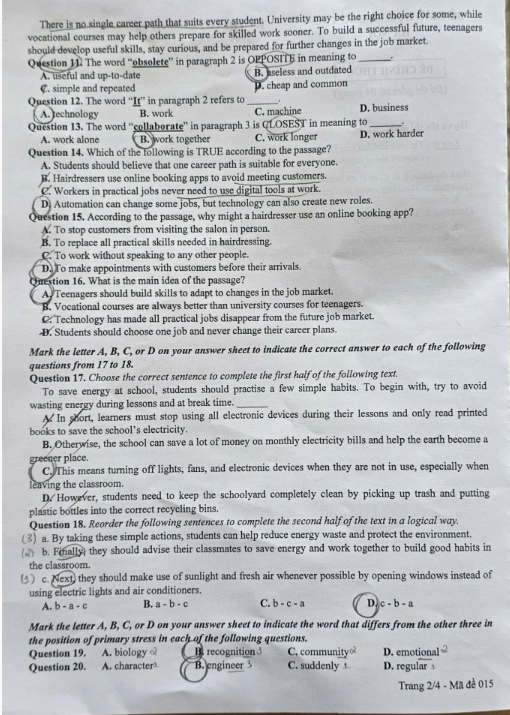
There is no single career path that suits every student. University may be the right choice for some, while vocational courses may help others prepare for skilled work sooner. To build a successful future, teenagers should develop useful skills, stay curious, and be prepared for further changes in the job market.
Question 11. The word "obsolete" in paragraph 2 is OPPOSITE in meaning to ______.
A. useful and up-to-date
B. useless and outdated
C. simple and repeated
D. cheap and common
Question 12. The word "It" in paragraph 2 refers to ______.
A. technology
B. work
C. machine
D. business
Question 13. The word "collaborate" in paragraph 3 is CLOSEST in meaning to ______.
A. work alone
B. work together
C. work longer
D. work harder
Question 14. Which of the following is TRUE according to the passage?
A. Students should believe that one career path is suitable for everyone.
B. Hairdressers use online booking apps to avoid meeting customers.
C. Workers in practical jobs never need to use digital tools at work.
D. Automation can change some jobs, but technology can also create new roles.
Question 15. According to the passage, why might a hairdresser use an online booking app?
A. To stop customers from visiting the salon in person.
B. To replace all practical skills needed in hairdressing.
C. To work without speaking to any other people.
D. To make appointments with customers before their arrivals.
Question 16. What is the main idea of the passage?
A. Teenagers should build skills to adapt to changes in the job market.
B. Vocational courses are always better than university courses for teenagers.
C. Technology has made all practical jobs disappear from the future job market.
D. Students should choose one job and never change their career plans.
Mark the letter A, B, C, or D on your answer sheet to indicate the correct answer to each of the following questions from 17 to 18.
Question 17. Choose the correct sentence to complete the first half of the following text.
To save energy at school, students should practise a few simple habits. To begin with, try to avoid wasting energy during lessons and at break time. ______
A. In short, learners must stop using all electronic devices during their lessons and only read printed books to save the school's electricity.
B. Otherwise, the school can save a lot of money on monthly electricity bills and help the earth become a greener place.
C. This means turning off lights, fans, and electronic devices when they are not in use, especially when leaving the classroom.
D. However, students need to keep the schoolyard completely clean by picking up trash and putting plastic bottles into the correct recycling bins.
Question 18. Reorder the following sentences to complete the second half of the text in a logical way.
a. By taking these simple actions, students can help reduce energy waste and protect the environment.
b. Finally, they should advise their classmates to save energy and work together to build good habits in the classroom.
c. Next, they should make use of sunlight and fresh air whenever possible by opening windows instead of using electric lights and air conditioners.
A. b - a - c
B. a - b - c
C. b - c - a
D. c - b - a
Mark the letter A, B, C, or D on your answer sheet to indicate the word that differs from the other three in the position of primary stress in each of the following questions.
Question 19. A. biology B. recognition C. community D. emotional
Question 20. A. character B. engineer C. suddenly D. regular
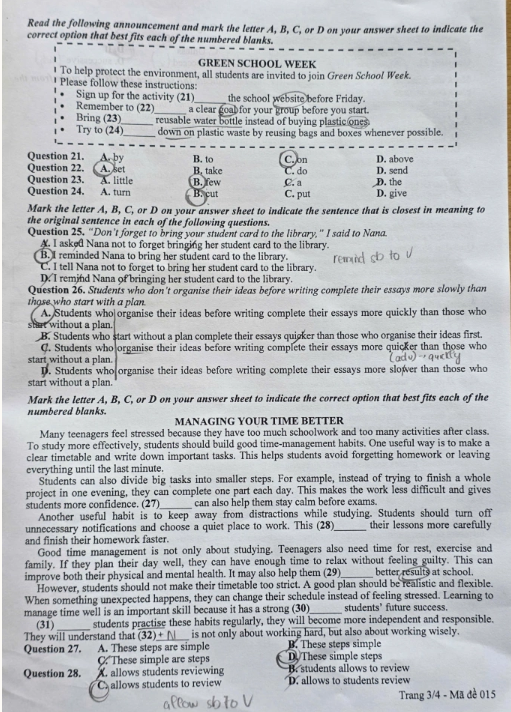
Read the following announcement and mark the letter A, B, C, or D on your answer sheet to indicate the correct option that best fits each of the numbered blanks.
GREEN SCHOOL WEEK
To help protect the environment, all students are invited to join Green School Week.
Please follow these instructions:
Sign up for the activity (21) ______ the school website before Friday.
Remember to (22) ______ a clear goal for your group before you start.
Bring (23) ______ reusable water bottle instead of buying plastic ones.
Try to (24) ______ down on plastic waste by reusing bags and boxes whenever possible.
Question 21. A. by B. to C. on D. above
Question 22. A. set B. take C. do D. send
Question 23. A. little B. few C. a D. the
Question 24. A. turn B. cut C. put D. give
Mark the letter A, B, C, or D on your answer sheet to indicate the sentence that is closest in meaning to the original sentence in each of the following questions.
Question 25. "Don't forget to bring your student card to the library," I said to Nana.
A. I asked Nana not to forget bringing her student card to the library.
B. I reminded Nana to bring her student card to the library.
C. I tell Nana not to forget to bring her student card to the library.
D. I remind Nana of bringing her student card to the library.
Question 26. Students who don't organise their ideas before writing complete their essays more slowly than those who start with a plan.
A. Students who organise their ideas before writing complete their essays more quickly than those who start without a plan.
B. Students who start without a plan complete their essays quicker than those who organise their ideas first.
C. Students who organise their ideas before writing complete their essays more quicker than those who start without a plan.
D. Students who organise their ideas before writing complete their essays more slower than those who start without a plan.
Mark the letter A, B, C, or D on your answer sheet to indicate the correct option that best fits each of the numbered blanks.
MANAGING YOUR TIME BETTER
Many teenagers feel stressed because they have too much schoolwork and too many activities after class. To study more effectively, students should build good time-management habits. One useful way is to make a clear timetable and write down important tasks. This helps students avoid forgetting homework or leaving everything until the last minute.
Students can also divide big tasks into smaller steps. For example, instead of trying to finish a whole project in one evening, they can complete one part each day. This makes the work less difficult and gives students more confidence. (27) ______ can also help them stay calm before exams.
Another useful habit is to keep away from distractions while studying. Students should turn off unnecessary notifications and choose a quiet place to work. This (28) ______ their lessons more carefully and finish their homework faster.
Good time management is not only about studying. Teenagers also need time for rest, exercise and family. If they plan their day well, they can have enough time to relax without feeling guilty. This can improve both their physical and mental health. It may also help them (29) ______ better results at school.
However, students should not make their timetable too strict. A good plan should be realistic and flexible. When something unexpected happens, they can change their schedule instead of feeling stressed. Learning to manage time well is an important skill because it has a strong (30) ______ students' future success.
(31) ______ students practise these habits regularly, they will become more independent and responsible. They will understand that (32) ______ is not only about working hard, but also about working wisely.
Question 27. A. These steps are simple B. These steps simple C. These simple are steps D. These simple steps
Question 28. A. allows students reviewing B. students allows to review C. allows students to review D. allows to students review
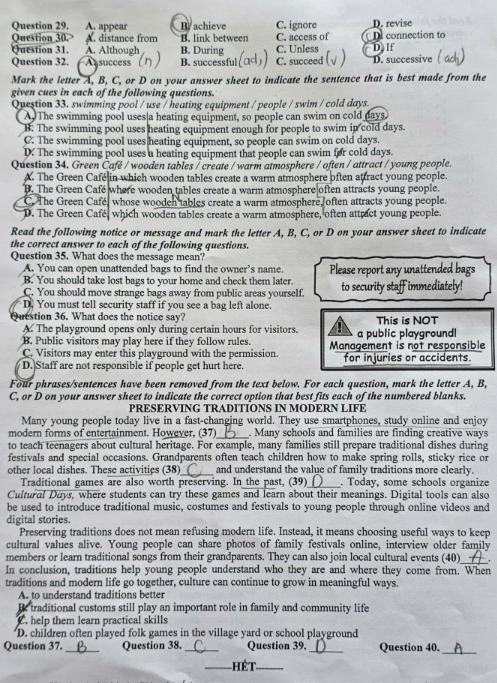
Question 29. A. appear B. achieve C. ignore D. revise
Question 30. A. distance from B. link between C. access of D. connection to
Question 31. A. Although B. During C. Unless D. If
Question 32. A. success B. successful C. succeed D. successive
Mark the letter A, B, C, or D on your answer sheet to indicate the sentence that is best made from the given cues in each of the following questions.
Question 33. swimming pool / use / heating equipment / people / swim / cold days.
A. The swimming pool uses a heating equipment, so people can swim on cold days.
B. The swimming pool uses heating equipment enough for people to swim in cold days.
C. The swimming pool uses heating equipment, so people can swim on cold days.
D. The swimming pool uses a heating equipment that people can swim for cold days.
Question 34. Green Café / wooden tables / create / warm atmosphere / often / attract / young people.
A. The Green Café in which wooden tables create a warm atmosphere often attract young people.
B. The Green Café where wooden tables create a warm atmosphere often attracts young people.
C. The Green Café, whose wooden tables create a warm atmosphere, often attracts young people.
D. The Green Café which wooden tables create a warm atmosphere, often attract young people.
Read the following notice or message and mark the letter A, B, C, or D on your answer sheet to indicate the correct answer to each of the following questions.
Question 35. What does the message mean?
[Box reads: Please report any unattended bags to security staff immediately!]
A. You can open unattended bags to find the owner's name.
B. You should take lost bags to your home and check them later.
C. You should move strange bags away from public areas yourself.
D. You must tell security staff if you see a bag left alone.
Question 36. What does the notice say?
[Box reads: This is NOT a public playground! Management is not responsible for injuries or accidents.]
A. The playground opens only during certain hours for visitors.
B. Public visitors may play here if they follow rules.
C. Visitors may enter this playground with the permission.
D. Staff are not responsible if people get hurt here.
Four phrases/sentences have been removed from the text below. For each question, mark the letter A, B, C, or D on your answer sheet to indicate the correct option that best fits each of the numbered blanks.
PRESERVING TRADITIONS IN MODERN LIFE
Many young people today live in a fast-changing world. They use smartphones, study online and enjoy modern forms of entertainment. However, (37) ______. Many schools and families are finding creative ways to teach teenagers about cultural heritage. For example, many families still prepare traditional dishes during festivals and special occasions. Grandparents often teach children how to make spring rolls, sticky rice or other local dishes. These activities (38) ______ and understand the value of family traditions more clearly.
Traditional games are also worth preserving. In the past, (39) ______. Today, some schools organize Cultural Days, where students can try these games and learn about their meanings. Digital tools can also be used to introduce traditional music, costumes and festivals to young people through online videos and digital stories.
Preserving traditions does not mean refusing modern life. Instead, it means choosing useful ways to keep cultural values alive. Young people can share photos of family festivals online, interview older family members or learn traditional songs from their grandparents. They can also join local cultural events (40) ______. In conclusion, traditions help young people understand who they are and where they come from. When traditions and modern life go together, culture can continue to grow in meaningful ways.
A. to understand traditions better
B. traditional customs still play an important role in family and community life
C. help them learn practical skills
D. children often played folk games in the village yard or school playground
Question 37: ______
Question 38: ______
Question 39: ______
Question 40: ______
GỢI Ý ĐÁP ÁN
PHẦN 1: NGỮ PHÁP & TỪ VỰNG (Câu 1 - 8)
Câu 1: D. demanding
-
Giải thích: Cần một tính từ để miêu tả công việc dạy trẻ em. Vế sau có giải thích "because it requires energy, creativity, and patience" (bởi vì nó đòi hỏi năng lượng, sự sáng tạo và kiên nhẫn). Do đó, đây là một công việc "đòi hỏi khắt khe" (demanding).
-
A. simple (đơn giản), B. hard-working (chăm chỉ - dùng cho người), C. private (riêng tư).
Câu 2: B. the less time they have
-
Giải thích: Cấu trúc so sánh kép (Double comparative): The + so sánh hơn + S + V, the + so sánh hơn + S + V (Càng... càng...). "Time" là danh từ không đếm được nên dùng "less" chứ không dùng "fewer".
-
Dịch: Thanh thiếu niên càng dành nhiều thời gian cho mạng xã hội, họ càng có ít thời gian cho các hoạt động ngoài trời.
Câu 3: A. No problem!
-
Giải thích: Tình huống giao tiếp. Du khách nói: "Cảm ơn bạn rất nhiều vì đã giúp đỡ." Đáp lại lời cảm ơn phổ biến và tự nhiên nhất là "No problem!" (Không có gì!).
-
B. Bạn hoàn toàn đúng!, C. Chắc chắn rồi! (Dùng để đồng ý lời mời/nhờ vả), D. Tôi hoàn toàn đồng ý (Dùng để tán thành ý kiến).
Câu 4: C. sold
-
Giải thích: Câu kể về một thói quen/hành động đã xảy ra và kết thúc trong quá khứ, dấu hiệu là "Back then" (Hồi đó) và động từ "ran" (quá khứ đơn của run). Động từ nối bằng liên từ "and" phải cùng thì quá khứ đơn.
-
Dịch: Hồi đó, mẹ cô ấy điều hành một sạp hàng nhỏ ở chợ làng, và bà luôn bán rau tươi cho các gia đình lân cận.
Câu 5: C. learn
-
Giải thích: Đây là câu điều kiện loại 1 dạng mệnh lệnh (đưa ra lời khuyên). Cấu trúc: If + S + V (hiện tại đơn), V-inf / Don't + V-inf. Ở vế chính, ta dùng động từ nguyên thể để tạo thành câu mệnh lệnh.
-
Dịch: Nếu bạn đến thăm một địa điểm mới, hãy tìm hiểu văn hóa và phong tục của nó để có cách cư xử phù hợp.
Câu 6: D. Maintaining
-
Giải thích: Cần một Danh động từ (V-ing) đứng đầu câu làm Chủ ngữ (Subject) cho động từ chính "helps". "Maintaining a healthy lifestyle" (Việc duy trì một lối sống lành mạnh) là một cụm danh động từ.
Câu 7: A. pursue
-
Giải thích: Cụm từ cố định (Collocation): pursue a dream (theo đuổi ước mơ).
-
B. win (chiến thắng), C. make (làm/tạo ra), D. carry (mang/vác).
Câu 8: A. cafeteria
-
Giải thích: "leftover food" (thức ăn thừa). Nơi hợp lý nhất trong trường học có thức ăn thừa là nhà ăn trường học (school cafeteria).
-
B. sân chơi, C. phòng thể chất, D. thư viện.
PHẦN 2: NGỮ ÂM (Câu 9 - 10)
Câu 9: B. performance
-
Giải thích: Chữ "a" trong các đáp án A, C, D đều được phát âm là âm bẹt /æ/ (anniversary, campus, distraction). Riêng đáp án B phát âm là âm ơ ngắn /ə/ (performance).
Câu 10: B. holography
-
Giải thích: Kiểm tra âm "h" câm. Các từ exhausted, honesty, honour có chữ "h" bị câm (không phát âm). Riêng holography chữ "h" được phát âm rõ ràng là /h/.
PHẦN 3: ĐỌC HIỂU 1 - HƯỚNG NGHIỆP (Câu 11 - 16)
Câu 11: A. useful and up-to-date
-
Giải thích: Đề bài hỏi từ trái nghĩa (OPPOSITE). "obsolete" nghĩa là lỗi thời, không còn được sử dụng nữa. Trái nghĩa với nó là hữu ích và cập nhật (useful and up-to-date).
Câu 12: A. technology
-
Giải thích: Đọc câu trước đó: "However, technology does not only take work away. It also creates new opportunities..." (Tuy nhiên, công nghệ không chỉ lấy đi việc làm. Nó còn tạo ra những cơ hội mới...). Đại từ "It" thay thế cho "technology".
Câu 13: B. work together
-
Giải thích: Đề bài hỏi từ đồng nghĩa (CLOSEST). "collaborate" nghĩa là hợp tác, làm việc cùng nhau, đồng nghĩa với work together.
Câu 14: D. Automation can change some jobs, but technology can also create new roles.
-
Giải thích: (Tự động hóa có thể thay đổi một số công việc, nhưng công nghệ cũng có thể tạo ra các vai trò mới). Đây là ý được nêu rõ ở đoạn 2: Máy móc làm nhiệm vụ nhanh hơn khiến một số việc lỗi thời, nhưng công nghệ cũng tạo ra cơ hội mới trong lĩnh vực kinh doanh trực tuyến, v.v. Các đáp án khác đi ngược lại với thông tin trong bài.
Câu 15: D. To make appointments with customers before their arrivals.
-
Giải thích: Dẫn chứng ở đoạn 3: "...and a hairdresser may use an online booking app to arrange visits and communicate with customers before they arrive." (để sắp xếp các chuyến thăm và giao tiếp với khách trước khi họ đến = đặt lịch hẹn).
Câu 16: A. Teenagers should build skills to adapt to changes in the job market.
-
Giải thích: Ý chính của bài là về việc thị trường việc làm đang thay đổi do công nghệ, và thanh thiếu niên cần phải trang bị, xây dựng các kỹ năng (cả kỹ thuật lẫn kỹ năng số/hợp tác) để thích ứng với những thay đổi này.
PHẦN 4: HOÀN THÀNH ĐOẠN VĂN - TIẾT KIỆM NĂNG LƯỢNG (Câu 17 - 18)
Câu 17: C
-
Giải thích: Câu trước nói về việc "tránh lãng phí năng lượng trong giờ học và giờ ra chơi". Câu tiếp theo cần giải thích cụ thể hành động đó là gì. Đáp án C: "Điều này có nghĩa là tắt đèn, quạt và các thiết bị điện tử khi không sử dụng..." là hoàn toàn logic.
Câu 18: D (c - b - a)
-
Giải thích: Cần sắp xếp theo trình tự logic của các bước tiết kiệm năng lượng:
-
Đoạn trước đã nói "To begin with..." (Bắt đầu với...).
-
(c) Tiếp theo (Next), nên tận dụng ánh sáng mặt trời...
-
(b) Cuối cùng (Finally), họ nên khuyên bạn cùng lớp...
-
(a) Bằng cách thực hiện những hành động đơn giản này (By taking these simple actions... - đây là câu kết luận, tóm lại tác dụng của các hành động đã kể ở trên).
-
=> Thứ tự đúng là: c - b - a.
-
PHẦN 5: TRỌNG ÂM (Câu 19 - 20)
Câu 19: B. recognition
-
Giải thích: * biology: trọng âm rơi vào âm tiết thứ 2.
-
recognition: đuôi -tion làm trọng âm rơi vào âm tiết liền trước nó, là âm tiết thứ 3.
-
community: trọng âm rơi vào âm tiết thứ 2.
-
emotional: trọng âm rơi vào âm tiết thứ 2.
-
Câu 20: B. engineer
-
Giải thích:
-
character: trọng âm âm tiết 1.
-
engineer: đuôi -eer nhận trọng âm, rơi vào âm tiết 3.
-
suddenly: trọng âm âm tiết 1.
-
regular: trọng âm âm tiết 1.
-
PHẦN 6: ĐIỀN TỪ - TUẦN LỄ TRƯỜNG HỌC XANH (Câu 21 - 24)
Câu 21: C. on
-
Giải thích: Giới từ đi với "website/Internet" luôn là "on" (trên trang web).
Câu 22: A. set
-
Giải thích: Cụm từ cố định: set a goal (đặt ra mục tiêu).
Câu 23: C. a
-
Giải thích: "reusable water bottle" (bình nước tái sử dụng) là cụm danh từ đếm được, số ít, bắt đầu bằng phụ âm, chưa xác định nên dùng mạo từ "a".
Câu 24: B. cut
-
Giải thích: Cụm động từ: cut down on something (cắt giảm cái gì đó).
PHẦN 7: VIẾT LẠI CÂU ĐỒNG NGHĨA (Câu 25 - 26)
Câu 25: B. I reminded Nana to bring her student card to the library.
-
Giải thích: Câu trực tiếp: "Don't forget to + V" (Đừng quên làm gì - mang tính nhắc nhở). Chuyển sang gián tiếp ta dùng cấu trúc: remind somebody to do something (nhắc nhở ai làm việc gì).
Câu 26: A. Students who organise their ideas before writing complete their essays more quickly than those who start without a plan.
-
Giải thích: Câu gốc: "Học sinh không sắp xếp ý tưởng... thì hoàn thành bài chậm hơn những người bắt đầu với một kế hoạch." Viết lại thành: "Học sinh có sắp xếp ý tưởng... thì hoàn thành bài nhanh hơn (more quickly) những người bắt đầu mà không có kế hoạch."
PHẦN 8: ĐIỀN TỪ KHUYẾT (QUẢN LÝ THỜI GIAN) (Câu 27 - 32)
Câu 27: D. These simple steps
-
Giải thích: Cần một cụm danh từ đóng vai trò Chủ ngữ. Trật tự đúng là: Từ chỉ định (These) + Tính từ (simple) + Danh từ số nhiều (steps).
Câu 28: C. allows students to review
-
Giải thích: Cấu trúc: allow somebody to do something (cho phép ai đó làm gì). "This" là chủ ngữ số ít nên động từ "allow" phải thêm "s".
Câu 29: B. achieve
-
Giải thích: Cụm từ: achieve better results (đạt được kết quả tốt hơn).
Câu 30: D. connection to
-
Giải thích: Cụm từ: have a connection to something (có sự liên kết/mối liên hệ với cái gì). "Learning to manage time... has a strong connection to students' future success."
Câu 31: D. If
-
Giải thích: Cần một liên từ chỉ điều kiện để tạo thành câu điều kiện loại 1. "Nếu học sinh thực hành những thói quen này thường xuyên, họ sẽ trở nên độc lập hơn."
Câu 32: A. success
-
Giải thích: Cần một Danh từ làm chủ ngữ cho mệnh đề "that... is not only about". "Success" (sự thành công) là danh từ. (B, D là tính từ; C là động từ).
PHẦN 9: NỐI CÂU & ĐỌC BIỂN BÁO (Câu 33 - 36)
Câu 33: C. The swimming pool uses heating equipment, so people can swim on cold days.
-
Giải thích: "Equipment" (trang thiết bị) là danh từ không đếm được trong tiếng Anh, do đó KHÔNG được dùng mạo từ "a" ở đằng trước. Loại đáp án A và D. Đáp án C sử dụng đúng cấu trúc nguyên nhân - kết quả (so).
Câu 34: C. The Green Café, whose wooden tables create a warm atmosphere, often attracts young people.
-
Giải thích: "The Green Café" là danh từ riêng, nên mệnh đề quan hệ phía sau phải là mệnh đề quan hệ không xác định (phải có dấu phẩy). Dùng đại từ quan hệ sở hữu "whose" để chỉ "những chiếc bàn gỗ CỦA quán cafe đó".
Câu 35: D. You must tell security staff if you see a bag left alone.
-
Giải thích: Biển báo ghi: "Vui lòng báo cáo bất kỳ chiếc túi vô chủ nào (unattended bags) cho nhân viên an ninh ngay lập tức!". Điều này đồng nghĩa với đáp án D.
Câu 36: D. Staff are not responsible if people get hurt here.
-
Giải thích: Biển báo ghi: "Đây KHÔNG phải là sân chơi công cộng! Ban quản lý không chịu trách nhiệm cho các chấn thương hay tai nạn." Điều này khớp với đáp án D.
PHẦN 10: HOÀN THÀNH ĐOẠN VĂN (BẢO TỒN TRUYỀN THỐNG) (Câu 37 - 40)
Câu 37: B
-
Giải thích: Câu trước nói về việc người trẻ sống trong thế giới hiện đại. Có từ "However" (Tuy nhiên), cần một câu mang ý nghĩa tương phản nhưng vẫn giữ gìn bản sắc: "Tuy nhiên, các phong tục truyền thống vẫn đóng vai trò quan trọng trong cuộc sống gia đình và cộng đồng."
Câu 38: C
-
Giải thích: Phía trước nhắc đến việc ông bà dạy làm nem rán, xôi... Vế sau chỗ trống là "and understand the value...". Chỗ trống cần điền là tác dụng của việc đó: "Những hoạt động này giúp họ học các kỹ năng thực tế (help them learn practical skills) và hiểu..."
Câu 39: D
-
Giải thích: Đứng sau cụm "In the past" (Trong quá khứ) để lấy ví dụ cho trò chơi truyền thống: "...trẻ em thường chơi các trò chơi dân gian trong sân làng hoặc sân trường."
Câu 40: A
-
Giải thích: "Họ cũng có thể tham gia các sự kiện văn hóa địa phương (để làm gì?)... để hiểu rõ hơn về các truyền thống (to understand traditions better)." Dùng to V để chỉ mục đích.
